

Deepthi Mahadevappa, PhD
Published Apr 13, 2026
Assessing Auditory Development Just Got Easier With LEAQ & ReDi
Early auditory development plays a critical role in a child’s spoken communication journey. Supporting families and professionals during these early years requires tools like ReDi and the LittlEARS ® Auditory Questionnaire that are simple, accessible, and practical in home and clinical environments.

Recent research shows that structured assessments like the LittlEARS ® Auditory Questionnaire (LEAQ) can effectively reflect changes in auditory behavior during early hearing development and relate those early patterns to later outcomes.Abdelhamid, N. H., Gaballah, M. M., Abdel Baky, M., & Sweedy, R. (2025). Cochlear Implant in Prelingual Children: Predicting the First-word Utterance from LittlEARS Auditory Questionnaire. International journal of pediatric otorhinolaryngology, 192, 112294. https://doi.org/10.1016/j.ijporl.2025.112294[1]Rauhamäki, T., Torppa, R., Henttonen, P., & Laakso, M. (2025). The early auditory development of finnish children with cochlear implants evaluated with the LittlEARS ® auditory questionnaire. International journal of pediatric otorhinolaryngology, 198, 112614. https://doi.org/10.1016/j.ijporl.2025.112614[2]Seebens, Y., Metzeld, D., Streicher, B., Glaubitz, C., Kronesser, D., Kreibohm-Strauß, K., Helbig, S., Schäfer, K., Kröger, S., Beck, R., & Aschendorff, A. (2025). Der LittlEARS ® Hörfragebogen: Auswertung multizentrischer Daten von Kindern nach früher bilateraler Cochleaimplantatversorgung [The LittlEARS ® Auditory Questionnaire : An analysis of multicentre data of children after early bilateral cochlear implant placement]. HNO, 73(5), 299–310. https://doi.org/10.1007/s00106-024-01509-9[3]
Alongside its existing rehabilitation features, ReDi now also supports early auditory assessment with the recent integration of the LittlEARS ® Auditory Questionnaire.
ReDi: A Connected Platform for Aural Rehabilitation
Since its launch in app stores worldwide, ReDi has become a widely used digital rehabilitation platform for over 25,000 hearing device users. Available in over 155 languages globally, ReDi uses AI (artificial intelligence) to support hearing device users with personalized and level-appropriate auditory and speech training when and where it is convenient for them.
The platform brings together rehabilitation tools in one place, allowing families to engage in rehabilitation activities at home while clinicians can follow progress remotely, adapt training plans, and stay connected with families. This connected approach supports a more structured and accessible rehabilitation process for everyone involved.
LittlEARS: A Trusted Tool for Early Auditory Assessment
The LittlEARS ® Auditory Questionnaire (LEAQ) is a standardized and widely used tool for monitoring auditory development in young children with hearing loss.Abdelhamid, N. H., Gaballah, M. M., Abdel Baky, M., & Sweedy, R. (2025). Cochlear Implant in Prelingual Children: Predicting the First-word Utterance from LittlEARS Auditory Questionnaire. International journal of pediatric otorhinolaryngology, 192, 112294. https://doi.org/10.1016/j.ijporl.2025.112294[1]Rauhamäki, T., Torppa, R., Henttonen, P., & Laakso, M. (2025). The early auditory development of finnish children with cochlear implants evaluated with the LittlEARS ® auditory questionnaire. International journal of pediatric otorhinolaryngology, 198, 112614. https://doi.org/10.1016/j.ijporl.2025.112614[2]Seebens, Y., Metzeld, D., Streicher, B., Glaubitz, C., Kronesser, D., Kreibohm-Strauß, K., Helbig, S., Schäfer, K., Kröger, S., Beck, R., & Aschendorff, A. (2025). Der LittlEARS ® Hörfragebogen: Auswertung multizentrischer Daten von Kindern nach früher bilateraler Cochleaimplantatversorgung [The LittlEARS ® Auditory Questionnaire : An analysis of multicentre data of children after early bilateral cochlear implant placement]. HNO, 73(5), 299–310. https://doi.org/10.1007/s00106-024-01509-9[3] It focuses on auditory milestones during the first 24 months of life or up to a hearing age of 24 months for children using hearing devices.
Quick Facts on the LEAQ
• Consists of 35 age-dependent yes or no questions
• Based on caregiver observations of their child’s everyday auditory behavior
• Backed by normative data from more than 3,300 children worldwide
• Recommended use at three-month intervals to track development over time
The questionnaire typically takes about 15 minutes to complete and allows professionals to monitor progress over time or compare results with age-matched normative data. LEAQ has long been trusted globally, and the LittlEARS ® Auditory Questionnaire is available in print in 45 languages.
LEAQ Is Now Integrated Into the ReDi App
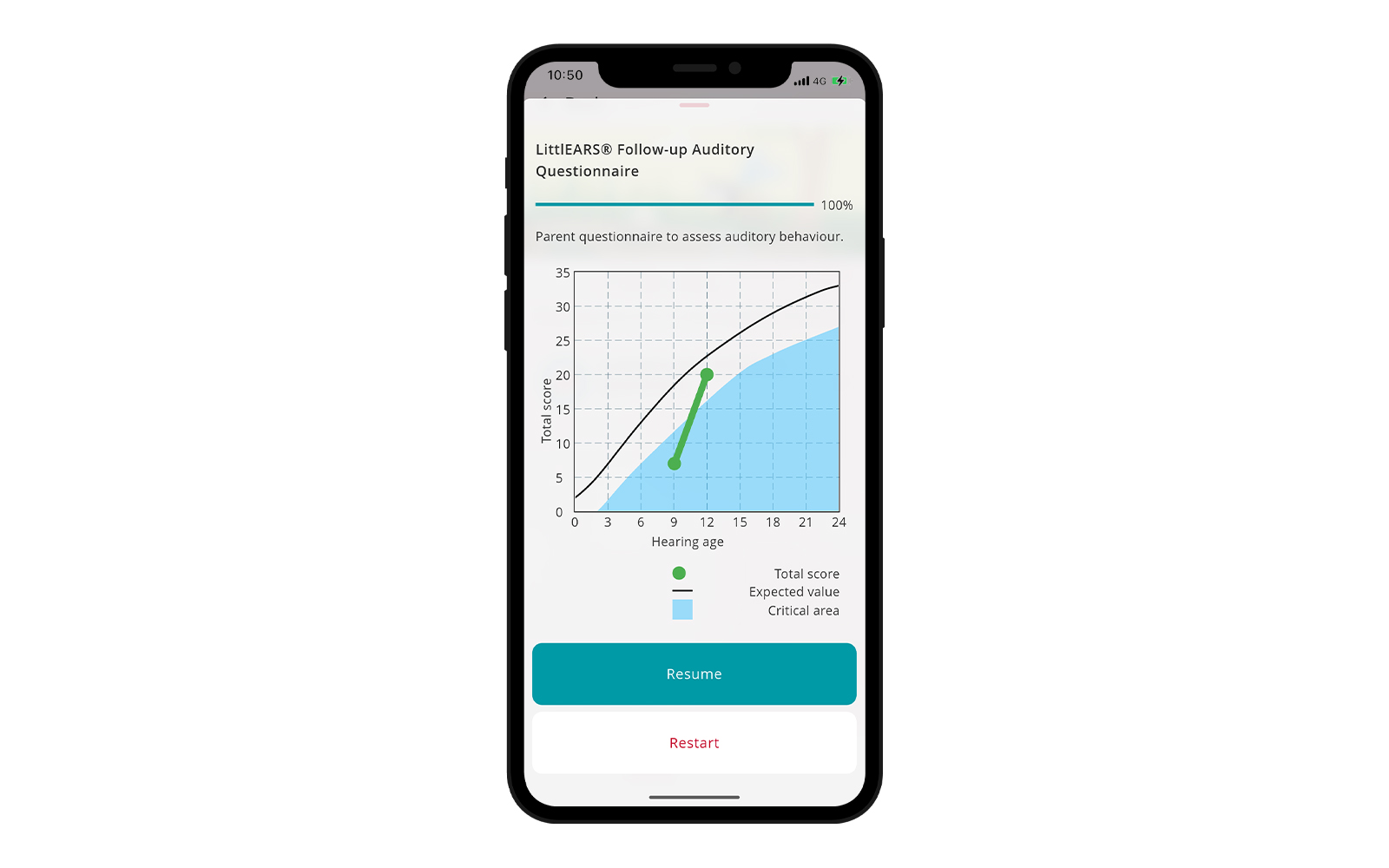
To simplify auditory assessment and improve accessibility, LEAQ is now fully integrated into the ReDi platform. It is currently available for English-speaking and Russian-speaking users, and it will soon be available in all 45 languages.
This integration allows caregivers to complete the assessment at home while clinicians can monitor results remotely, supporting timely follow-up and continuous tracking of progress along the rehabilitation journey.
Key Advantages of LEAQ on the ReDi App
- Compares child’s score with normative data using automatic progress graphs
- Supports clinical goal-setting and early identification of delayed progress
- Allows professionals to review caregiver submissions remotely
- Available in English and Russian, with 43 other languages coming soon
How to Access the LEAQ in ReDi
For Parents
The LittlEARS ® Auditory Questionnaire is available directly in the ReDi App on iOS and Android devices:
- Download the ReDi app from the App Store or Google Play Store.
- Log in to your ReDi account.
- Navigate to “Courses” in the bottom menu.
- Select “Others”
- Choose “LittlEARS ® Auditory Questionnaire” and complete the questionnaire.
After completing the questionnaire:
- The score and progress graph are displayed immediately upon submission.
- Results are securely stored and remain accessible at any time within the app.
- The questionnaire will be available again after three months to support timely follow-up.
For Professionals
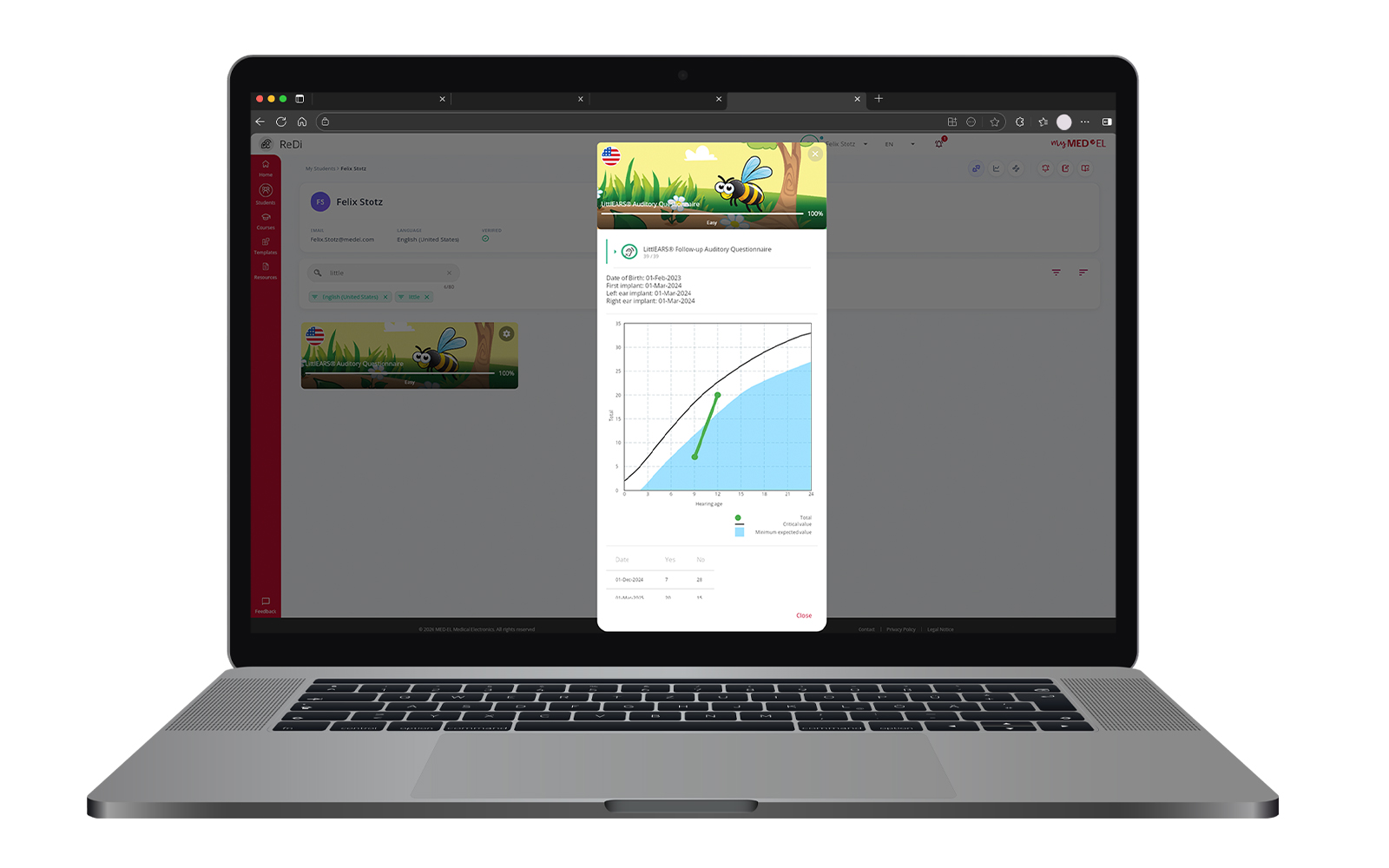
Professionals can access all LEAQ results through ReDi Studio.
- View completed results and progress graphs for all assigned patients
- Reassign the questionnaire earlier than the three-month interval if clinically required:
1. Log in to ReDi Studio
2. Locate the patient
3. Manually reassign the LEAQ
Supporting Early Auditory Development Together

By integrating LEAQ into ReDi, early auditory assessment and rehabilitation are now fully connected within one digital platform. This supports consistent monitoring, easier follow-up, and closer collaboration between caregivers and professionals, helping children with hearing loss build the foundations for spoken communication from the very beginning.
If you would like to explore ReDi for your clinic or are interested in having LEAQ available in your language, we are here to support you.
Important Information About the Previous LEAQ App
- The standalone LEAQ app is no longer supported. Existing users may still access it, but future device updates may affect functionality. Email reporting is no longer available.
- Due to privacy regulations, MED‑EL cannot access or migrate data from the former app. All information remains solely on the user’s device.
References
-
[1]
Abdelhamid, N. H., Gaballah, M. M., Abdel Baky, M., & Sweedy, R. (2025). Cochlear Implant in Prelingual Children: Predicting the First-word Utterance from LittlEARS Auditory Questionnaire. International journal of pediatric otorhinolaryngology, 192, 112294. https://doi.org/10.1016/j.ijporl.2025.112294
-
[2]
Rauhamäki, T., Torppa, R., Henttonen, P., & Laakso, M. (2025). The early auditory development of finnish children with cochlear implants evaluated with the LittlEARS ® auditory questionnaire. International journal of pediatric otorhinolaryngology, 198, 112614. https://doi.org/10.1016/j.ijporl.2025.112614
-
[3]
Seebens, Y., Metzeld, D., Streicher, B., Glaubitz, C., Kronesser, D., Kreibohm-Strauß, K., Helbig, S., Schäfer, K., Kröger, S., Beck, R., & Aschendorff, A. (2025). Der LittlEARS ® Hörfragebogen: Auswertung multizentrischer Daten von Kindern nach früher bilateraler Cochleaimplantatversorgung [The LittlEARS ® Auditory Questionnaire : An analysis of multicentre data of children after early bilateral cochlear implant placement]. HNO, 73(5), 299–310. https://doi.org/10.1007/s00106-024-01509-9
References
Deepthi Mahadevappa, PhD
Deepthi Mahadevappa, PhD, is a speech language pathologist currently working as a rehabilitation manager at MED-EL headquarters in Innsbruck, Austria. Deepthi has many years of experience working in the field of hearing loss in clinical and educational settings. At present, she contributes to the development of digital rehabilitation tools and supports rehabilitation professionals globally.


Was this article helpful?
Thanks for your feedback.
Sign up for newsletter below for more.
Thanks for your feedback.
Please leave your message below.
CTA Form Success Message
Send us a message
Field is required
John Doe
Field is required
name@mail.com
Field is required
What do you think?
The content on this website is for general informational purposes only and should not be taken as medical advice. Please contact your doctor or hearing specialist to learn what type of hearing solution is suitable for your specific needs. Not all products, features, or indications shown are approved in all countries.
Deepthi Mahadevappa, PhD
Deepthi Mahadevappa, PhD, is a speech language pathologist currently working as a rehabilitation manager at MED-EL headquarters in Innsbruck, Austria. Deepthi has many years of experience working in the field of hearing loss in clinical and educational settings. At present, she contributes to the development of digital rehabilitation tools and supports rehabilitation professionals globally.