Join Clinicians Worldwide
Evidence-based insights to enhance hearing care—twice a month
Subscribe Now English - International
Evidence-based insights to enhance hearing care—twice a month
Subscribe Now
MED-EL
Published Mar 01, 2017

Whether it’s a slip on the way to the mailbox or a fall while climbing a tree, accidents happen. Thankfully, titanium cochlear implants are generally robust against impact—but they can be dislodged if not thoroughly secured.1
Currently, there are several means of implant fixation in common use. Most often, a bony well is used to provide a stable bed for the receiver housing.2 This is usually combined with suturing across the implant for secure placement.1,2,3
However, a recessed implant bed can require significant drilling. This can expose the dura mater and increase the risk of complications—especially for children and patients with thinner temporal bone.2,4 Additionally, fixation of the stimulator housing with sutures requires a larger incision in order to expose the area surrounding the receiver bed. This can lead to increased scarring and risk of post-operative wound complication.1,3,4,5
Preparing a tight subperiosteal pocket allows you to minimize the size of the incision, avoids excessive drilling, and even eliminates the use of implant fixation sutures. However, reliance on a tight subperiosteal pocket alone can limit positioning options and fixation may be less secure.1 This is a significant consideration, especially for children, as they are prone to minor impacts to the head in everyday life.4,6
Therefore, an ideal fixation method would combine the best of both:
A) The long-term stability possible by drilling a bony well with fixation sutures.
B) The small incision and minimal drilling approach of a tight subperiosteal pocket.
In order to provide best of both, MED-EL developed the PIN implant housing. This design offers a reliable option for minimally invasive surgery and simple, secure fixation.1,3,4
The SYNCHRONY PIN Cochlear Implant offers reliable implant fixation with:
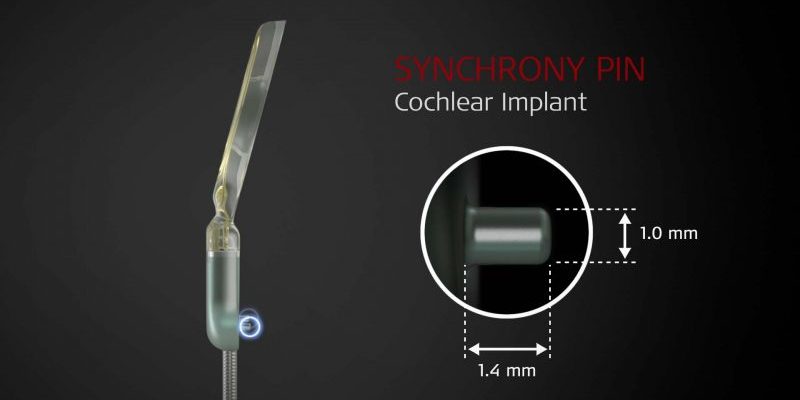
SYNCHRONY PIN has two small (1.0x 1.4 mm) titanium fixation pins built into the receiver housing. These durable pins are designed to lock into corresponding holes drilled in the bone. This direct mechanical connection to the temporal bone provides superior fixation against lateral and rotational forces. Together with a sufficiently recessed electrode channel to protect the electrode lead, this provides excellent implant stability and security. Schnabl et al. (2012) found that even 100 N of force applied directly to the side of the PIN implant housing did not dislocate the implant.1
Furthermore, the area beneath the receiver housing only needs to be flattened. This minimizes the need for drilling and reduces the risk of exposing the dura mater, especially for patients with thin temporal bone.1,4
There’s no need for sutures to fixate the implant, so you won’t need to expose the area over the implant. This allows you to place the implant securely in a tight subperiosteal pocket.3,4 Only a small incision is needed behind the pinna. The small incision can reduce the risk of complications, enables faster wound healing, and minimizes visible scarring.3,4,5,6
This simplifies surgery for you and offers better outcomes for your patients.1,2,3,4,5,6,7
The benefits of PIN for you:
The benefits of PIN for your patients:
With straightforward implant fixation, SYNCHRONY PIN offers surgical simplicity, faster recovery, and long-term reliability.3,4,7
Want to start using SYNCHRONY PIN in your clinic? Contact your local MED-EL representative today.
Don’t miss the next post—subscribe now and you’ll receive new updates right in your inbox.
*Not all products and features shown are available in all areas. Please contact your local MED-EL representative for more information.
References:
MED-EL
Was this article helpful?
Thanks for your feedback.
Sign up for newsletter below for more.
Thanks for your feedback.
Please leave your message below.
CTA Form Success Message
Send us a message
Field is required
John Doe
Field is required
name@mail.com
Field is required
What do you think?
The content on this website is for general informational purposes only and should not be taken as medical advice. Please contact your doctor or hearing specialist to learn what type of hearing solution is suitable for your specific needs. Not all products, features, or indications shown are approved in all countries.
MED-EL
Get the latest research and resources to help people with every kind of hearing loss. Subscribe to the MED-EL Professionals Blog now.
Registration was successful
We’re the world’s leading hearing implant company, on a mission to help people with hearing loss experience the joy of sound.
Find your local MED-EL team
The content on this website is for general informational purposes only and should not be taken as medical advice. Please contact your doctor or hearing specialist to learn what type of hearing solution is suitable for your specific needs. Not all products, features, or indications shown are approved in all countries.