English - United States
English - United States
 English - United States
Popular Topics:
Popular Topics:

Published Jun 11, 2026

Female Patient And Nurse Have Consultation In Hospital Room
“Tonotopy is really a fundamental principle of the cochlea. Do cochlear implants also make use of the tonotopy of the human cochlea?”
Peter Nopp
Director of Research – Signal Processing, MED-EL
On this episode of the Closest to Natural Hearing podcast, MED-EL’s Head of R&D, Peter Nopp, discusses the benefits of individualizing a patient’s cochlear implant according to their unique anatomy with Professor Griet Merten and Dr. Masoud Zoka Assadi. First, recognizing the natural tonotopic structure of the cochlea and choosing an electrode array that will most closely align with the size of that cochlea is crucial. Professor Merten explains, “when the same electrode array is used, let’s say a FLEX 28 electrode array, in someone with a relatively long cochlear duct length, this results in a smaller angular insertion depth compared to someone with a shorter cochlear duct length. So, if we then apply the default CI frequency allocations in those two patients, the mapping will match the natural tonotopy more closely for one person than for the other.”
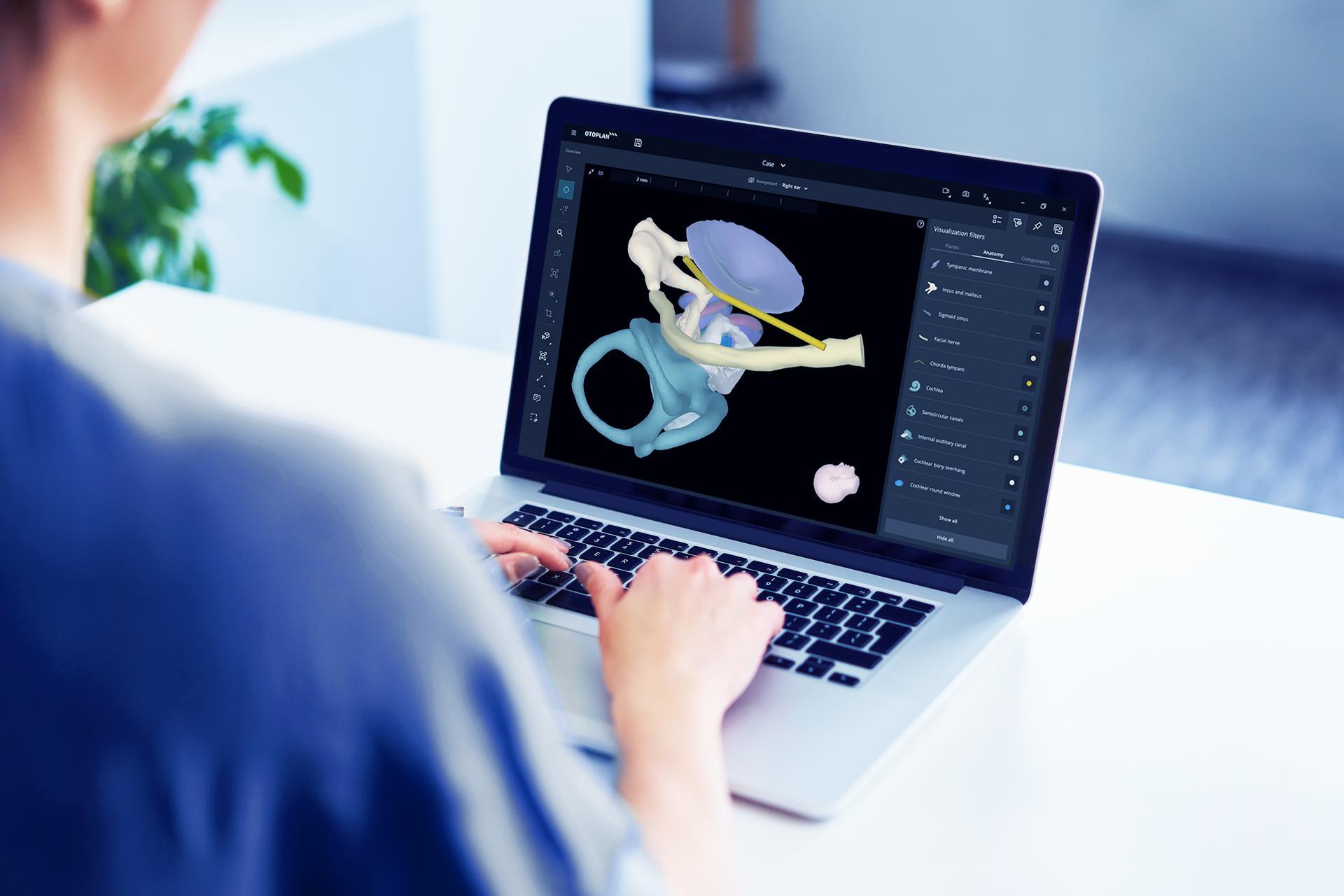
MED-EL helps surgeons choose the correct size of electrode array through our exclusive mapping software called OTOPLAN. Dr. Assadi explains, “Traditionally, the electrode length was chosen based on a general preference or on a one-size-fits-most approach. An anatomy-based electrode selection with OTOPLAN, on the other hand, is different because this starts with patient’s anatomy.”
Woman working on laptop at desk. Laptop mock-up
“First, the software, OTOPLAN, creates the 3D reconstruction of the cochlea, including the scala tympani, and provides automatic measurements of the key cochlear parameters. […] Additionally, you can also add the patient's audiological information to the planning, and then the software combines this audiological and anatomical information to help you to compare different electrode arrays within the specific cochlea. […] And using all this information, one can select the most suitable electrode array that best matches both the anatomical and audiological needs of the patient rather than relying on a generic solution.”
Dr. Masoud Zoka Assadi
Head of Precision Surgery, MED-EL Research & Development
This means that by using OTOPLAN to choose the right electrode array, you can minimize the frequency-to-place mismatch, or “the mismatch between the default frequency allocation of the CI and the actual tonotopic frequency of the cochlear neurons.” And in Professor Mertens’ research, she “found that the smaller the mismatch observed, the better the speech perception outcomes at six months” for her patients. But it doesn’t stop there. After implantation, audiologists can use OTOPLAN once again to even further align the cochlear implant with the patient’s natural ear structures, using Anatomy-Based Fitting. For Professor Mertens, “After surgery, we always schedule a post-op CT scan in all of our adult CI recipients, and then we can calculate this remaining mismatch that you are mentioning, and that allows us then to minimize this remaining mismatch during our Anatomy-Based Fitting. So it enables us to, again, better align the frequency map stimulated by the CI with a measured natural place-to-frequency match at that specific electrode contact.”
This is ultimately what we mean by achieving the closest to natural hearing. By aligning the electrical device with the organic structure of the cochlea, recipients are able to experience hearing how the ear was designed to function. Dr. Mertens explains the significance of this process by citing the multiple studies which are emerging, showcasing how powerful OTOPLAN and ABF can be for patients. She says, “the patients fitted with ABF, so with anatomy-based fitting, achieved better results on music perception tasks from the Meludia application. Then there was also a study showing improved speech understanding in noise. […] They found that anatomy-based fitting led to significantly better speech understanding in noise in comparison to the default fitting approach.”
Curious to learn more about how MED-EL is revolutionizing the world of cochlear implants through individualized care and what that could mean for your patients? Listen to the rest of this week’s podcast and reach out to your MED-EL rep for more info!
References
Was this article helpful?
Thanks for your feedback.
Sign up for newsletter below for more.
Thanks for your feedback.
Please leave your message below.
Thanks for your message. We will reply as soon as possible.
Send Us a Message
Field is required
John Doe
Field is required
name@mail.com
Field is required
What do you think?
© MED-EL Medical Electronics. All rights reserved. The content on this website is for general informational purposes only and should not be taken as medical advice. Contact your doctor or hearing specialist to learn what type of hearing solution suits your specific needs. Not all products, features, or indications are approved in all countries.
We’re the world’s leading hearing implant company, on a mission to help people with hearing loss experience the joy of sound.
Find your local MED-EL team
© MED-EL Medical Electronics. All rights reserved. The content on this website is for general informational purposes only and should not be taken as medical advice. Contact your doctor or hearing specialist to learn what type of hearing solution suits your specific needs. Not all products, features, or indications are approved in all countries.