English - United States
English - United States
 English - United States
Popular Topics:
Popular Topics:

Published Jun 30, 2026

“If you've ever wondered how much the right frequency alignment matters, or how ABF can improve clarity, comfort, and speech understanding, then this episode is for you.”
Jennifer Robinson
Corporate Director of Product Management Hearing Solutions
This week’s episode features Dr. Anja Kurz and Dr. Margaret Dillon. in conversation with Jennifer Robinson, MED-EL’s Director of Product Management, discussing the science behind Anatomy-Based Fitting (ABF), its clinical impact, and their research into the outcomes of this process. To begin, Dr. Kurz explains how the cochlea is organized according to sound frequencies, starting with high pitches at the base, and low pitches at the apex. “This means the ear doesn’t just detect sound, it maps the pitch to a place.” (Kurz)
Dr. Dillon follows this by explaining that when a cochlear implant does not align with the natural structure of the cochlea, a frequency-place mismatch can occur. This discrepancy between the frequency information being received by the cochlear implant and the normal tonotopic place of the cochlea can cause a number of problems for CI users. Specifically, Dr. Dillon states that patients with significant mismatch tend to have “poor speech recognition, even six or 12 months following activation.”
To address this problem, MED-EL uses a process called Anatomy-Based Fitting to program our cochlear implants. Dr. Kurz defines “Anatomy-Based Fitting, explained very easily, is to stimulate the place with the correct frequency. It’s just making sure that we are stimulating the right spot.” But in order to do so, one must have access to the whole range of frequencies in the cochlea. An electrode array that is too short to reach the deeper parts of the cochlea will have a “natural frequency-to-place mismatch” from the very beginning. This is one of the reasons why achieving full cochlear coverage is critical to the success of the implant.
We conducted this randomized study where conventional cochlear implant patients received either the 31.5 [mm] or a shorter electrode array. And what we found was that patients who received that longer array did better faster than those that had the shorter array, and that was observed out to 12 months. In a follow up study, we looked out to four years […] and saw that those differences in speech recognition remained between those two groups out to four years.
Margaret Dillon, AuD, PhD
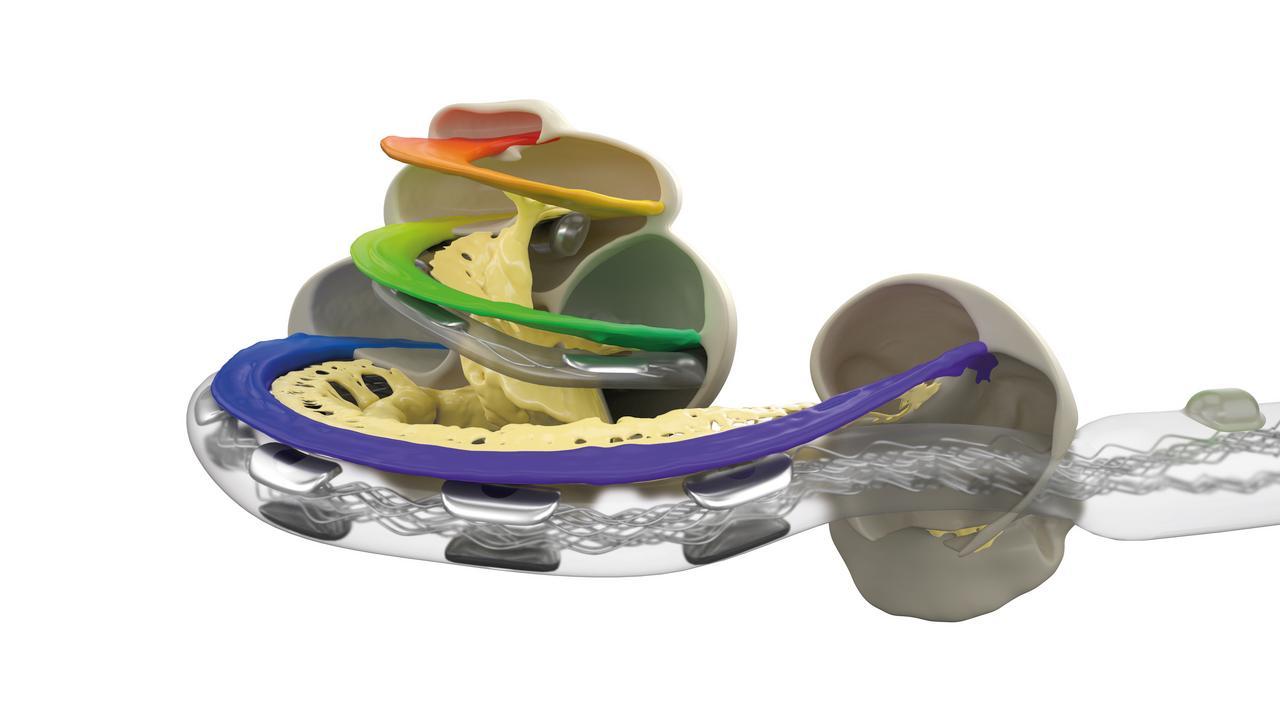
In light of the growing amount of research supporting ABF and the importance of matching the electrode array to natural cochlear anatomy, both Drs. discussed how this process is becoming increasingly standard in clinics. According to Dr. Kurz, “what we saw over time is that indeed, the same as Meg just described, that those patients that were fitted with ABF right from the beginning performed much better than the other group.” Because of this, “ABF is in our day-to-day business. I mean, every patient that comes in […] is getting a preoperative MRI and then postoperative it’s a standard that we are doing a photon-counting CT.” More and more clinicians are realizing that with ABF, you don’t have to settle for averages to decide on the best array and implant for your patient.
To learn more about how MED-EL is helping clinicians achieve the closest to natural hearing for their patients with Anatomy-Based Fitting, listen to the whole podcast here.
References
Was this article helpful?
Thanks for your feedback.
Sign up for newsletter below for more.
Thanks for your feedback.
Please leave your message below.
Thanks for your message. We will reply as soon as possible.
Send Us a Message
Field is required
John Doe
Field is required
name@mail.com
Field is required
What do you think?
© MED-EL Medical Electronics. All rights reserved. The content on this website is for general informational purposes only and should not be taken as medical advice. Contact your doctor or hearing specialist to learn what type of hearing solution suits your specific needs. Not all products, features, or indications are approved in all countries.
We’re the world’s leading hearing implant company, on a mission to help people with hearing loss experience the joy of sound.
Find your local MED-EL team
© MED-EL Medical Electronics. All rights reserved. The content on this website is for general informational purposes only and should not be taken as medical advice. Contact your doctor or hearing specialist to learn what type of hearing solution suits your specific needs. Not all products, features, or indications are approved in all countries.