



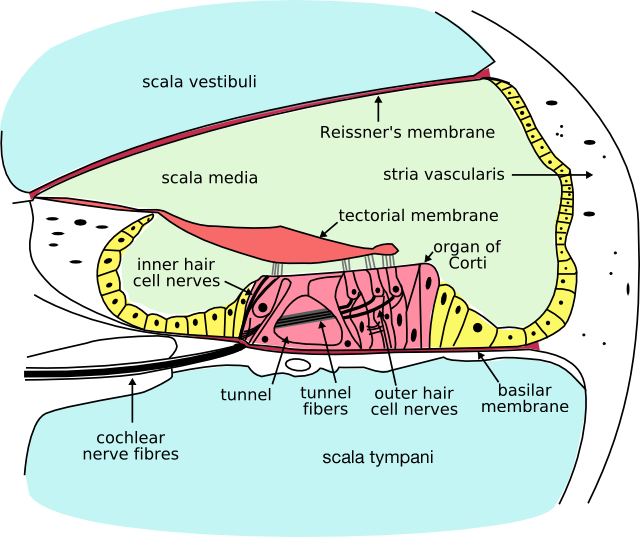
Image courtesy of Dr. Bechara Kachar, NIDCD, NIH
The scala tympani is the optimal location for a cochlear implant array.1 In the scala tympani, the array rests below the basilar membrane and stimulates neural tissues in the immediate turn, including spiral ganglion cells, neurites, and axons.2 This enables accurate tonotopic mapping as described by the Greenwood function.
However, the basilar membrane and other cochlear structures are extremely fragile—so it’s no surprise that, depending on design and other factors, electrode arrays may deviate from the scala tympani into the scala vestibuli.
What’s the result?
Intracochlear Fluids
Let’s start by taking a look at the intracochlear fluids. Between the endolymph and the perilymph, there’s a battery-like electrochemical ion gradient that’s necessary for maintaining the endocochlear potential. This potential is essential for any natural inner ear function—without this ion gradient, hair cells would likely not be able to initiate action potentials in the auditory nerve.3
- Endolymph (scala media) has high K+ and low Na+ (+80 mV)
- Perilymph (scala tympani & scala vestibuli) has low K+ and high Na+ (~0 mV)
Electrode Deviation
The endolymph is contained in the scala media, between the basilar membrane and Reissner’s membrane. So if an electrode array deviates from the scala tympani into the scala vestibuli, it would damage the basilar membrane and the endolymph and perilymph could mix. If these fluids are able to mix, the ion gradient and the endocochlear potential would both be lost.3
- Loss of natural hearing function 3,4
- Damage to neural structures 1,3
- Loss of potential for future therapies
Preserving cochlear structures isn’t only important for candidates with residual hearing. An electrode in scala vestibuli is more likely to stimulate spiral ganglion cells in more than one turn, leading to cross-turn stimulation and pitch confusion.2
- Likely loss of residual hearing 3
- Possible pitch confusion 2
- Significantly lower speech perception scores 2,5,6
Structure Preservation
In contrast, an electrode array placed fully within the scala tympani offers many benefits. There are the tangible benefits of better speech perception and possibility of useful residual hearing—but there’s also the preservation of neural structures and the natural hearing pathway for future therapies.
- Significantly better speech perception scores 2,5,6
- Possibility of residual natural hearing function 3,4
- Preservation the neural reserve of the patient 1,3
- Intact natural hearing structures for future therapies 3
Clearly, the ideal outcome for any cochlear implant patient would be an array fully within the scala tympani. So it’s fair to say that electrode deviation should be avoided whenever possible. But is it possible to effectively reduce the risk of electrode deviation?
Subscribe today to make sure you don’t miss part two of this post!
*Not all products and features shown are available in all areas. Please contact your local MED-EL representative for more information.
References:
- O’Connell, B.P., Hunter, J.B., & Wanna, G.B., (2016). The importance of electrode location in cochlear implantation. Laryngoscope Investigative Otolaryngology, 1: 169–174.
- Holden, L.K, Finley, C.C., Firszt, J.B., Holden, T.A., Brenner, C, Potts, L.G., Gotter, B.D., Vanderhoof, S.S., Mispagel, K., Heydebrand, G., & Skinner, M.W. (2013) Factors affecting open-set word recognition in adults with cochlear implants. Ear Hear. 34(3):342–360.
- Nin, F., Hibino, H., Doi, K., Suzuki, T., Hisa, Y., & Kurachi, Y. (2008) The endocochlear potential depends on two K+ diffusion potentials and an electrical barrier in the stria vascularis of the inner ear. Proc Natl Acad Sci USA. 105(5):1751–1756.
- Wanna, G.B., Noble, J.H., Gifford, R.H., Dietrich, M.S., Sweeney, A.D., Zhang, D., Dawant, B.M., Rivas, A., & Labadie, R.F. (2015) Impact of intrascalar electrode location, electrode type, and angular insertion depth on residual hearing in cochlear implant patients: Preliminary results. Otol Neurotol. 36(8):1343–1348.
- Wanna, G.B., Noble, J.H., Carlson, M.L., Gifford, R.H., Dietrich, M.S., Haynes, D.S., Dawant, B.M., & Labadie, R.F. (2014) Impact of electrode design and surgical approach on scalar location and cochlear implant outcomes. Laryngoscope. 124(6):1–7.
- O’Connell, B.P., Cakir, A., Hunter, J.B., Francis, D.O., Noble, J.H., Labadie, R.F., Zuniga, G., Dawant, B.M., Rivas, A., & Wanna, G.B. (2016) Electrode location and angular insertion depth are predictors of audiologic outcomes in cochlear implantation. Otol Neurotol. 37(8):1016–1023.


Conversation
1 Comment